Launch price until the first exam: CHF 3'250 instead of CHF 6'500 Claim a place
Scholé
For education providers Log in Sample lesson

First exam: 29 October to 13 November 2026 The Swiss federal exam, held for the first time.

Ready for the AI Business Specialist federal diploma.

Adaptive lessons along the official directive, case-study training and a role-play simulator for the oral exam parts. They carry 75 percent of your grade, and they are the part you cannot practise anywhere else.

app.schole.ai
Area B, Lesson 3 Role play

Comparing value and feasibility

Section 2 of 4

A use case promises high value, but the data situation is unclear. Where does it belong in the prioritisation matrix?

  • On the review list: value is high, clarify feasibility first.
  • Straight into implementation, value is what decides.
  • Rule it out, unclear data is an exclusion criterion.

This is what a lesson looks like. The real one opens in a new tab, free and without signup.

What this course does differently

The exam is new, so there is no collection of past papers yet and no established learning material. What does exist: the official documents. The course is built on those.

Learn

Adaptive lessons

The platform first checks what you already know and adapts the lessons to it. The structure follows the official competency framework. You do not sit through chapters you mastered long ago.

Part 3

Practise the oral exam

The role play simulator trains exam part 3, the critical incidents. You speak, the other side answers, and afterwards you get feedback along the assessment dimensions of the exam.

Part 2

Case studies and explainer videos

Training for the written case studies in exam part 2, plus short explainer videos for every concept. Read, listen or apply it directly, depending on how you learn.

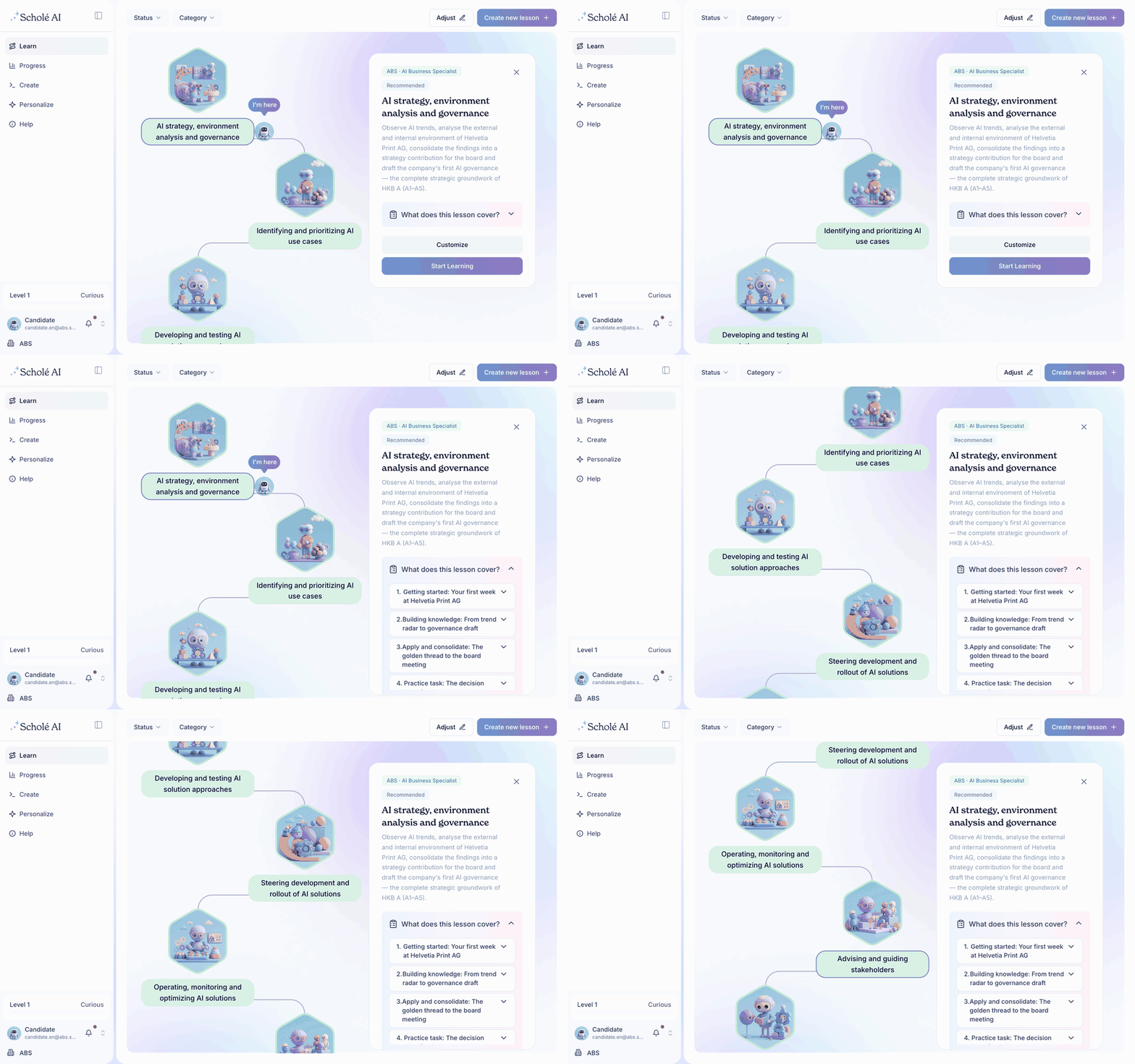
The ABS course in Scholé: learning path and lesson contents
The course as it stands todayAll eight lessons along the official directive, with the sections of each lesson.
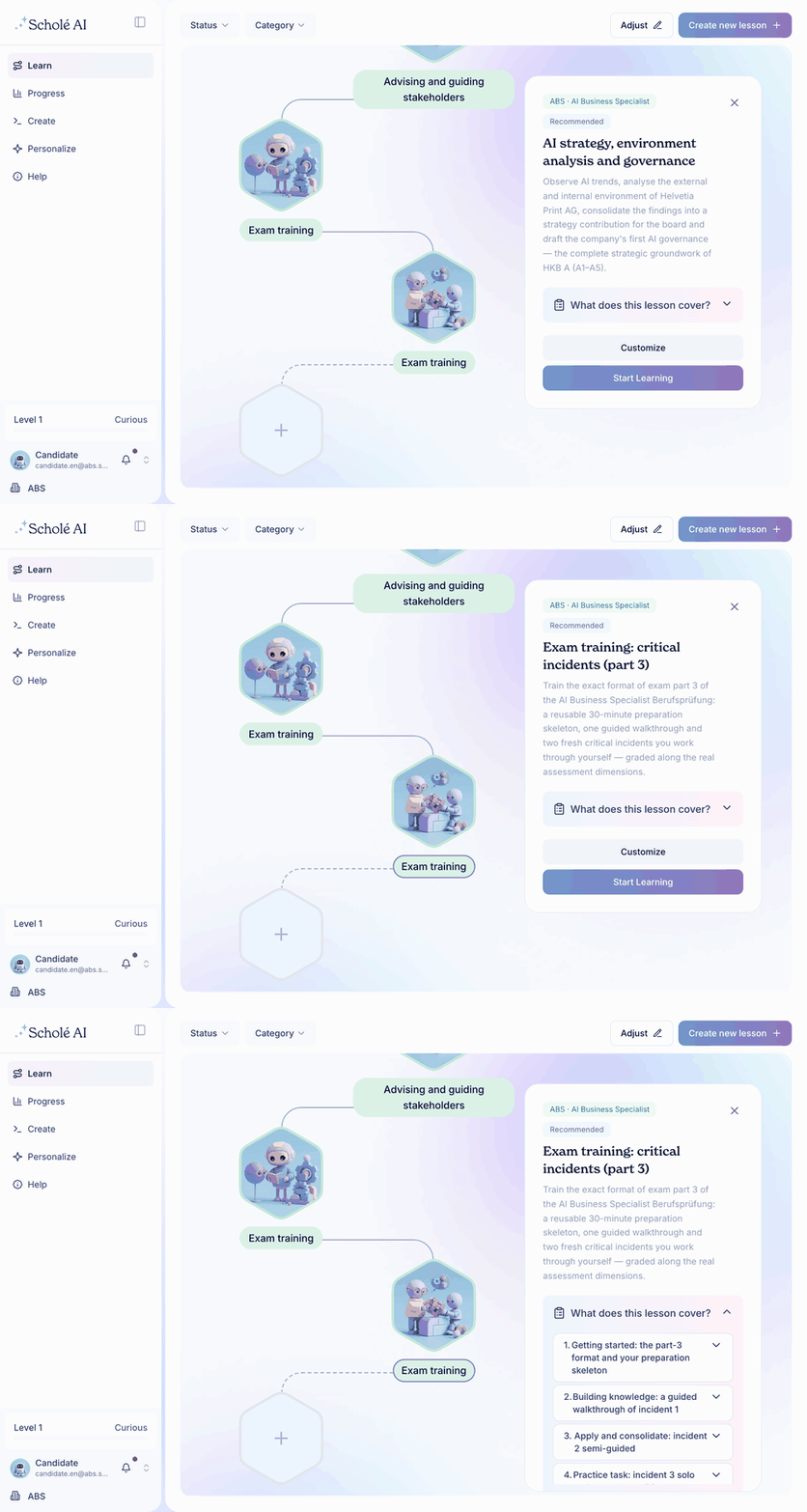
Exam training part 3: the three critical incidents
Exam part 3: the critical incidentsOne guided walkthrough, one semi-guided, and one solo under exam conditions.

How the course runs

Five stages, from the first assessment to the last check before you register.

  1. Starting assessment. A short check shows where you stand. Your learning path comes out of that, instead of one fixed order for everyone.
  2. Learning along the six areas of competence. A to F: AI strategy and governance, spotting where AI can be used, developing solution approaches, steering development and rollout, optimising operations, advising stakeholders. Competencies B3 and C3 to C5, compulsory for part 1, sit inside them.
  3. Case study training (part 2). You practise the format of the written case studies: reading technique, breaking down the task, answer structure, time budget.
  4. Role play simulation (part 3). Critical incidents in conversation, with feedback after every round. As often as you want, with nobody watching.
  5. Check your exam readiness. One last run shows which competencies are still shaky. That tells you what takes priority in the final weeks.

Before you start

What exactly is this diploma and when is the exam?

The AI Business Specialist (Swiss federal diploma) is earned through a Swiss federal professional examination. The exam has three parts. Part 1, project presentation and technical discussion, counts 50 percent. Part 2, written case studies, counts 25 percent. Part 3, oral critical incidents, counts 25 percent.

The first exam window runs from 29 October to 13 November 2026. You are admitted with an EFZ (Swiss federal VET certificate) in ICT plus two years of professional experience, or any EFZ plus four years of professional experience. The examination regulations and the directive are always what count.

Which languages is the course available in?

German, English, French and Italian. You choose your language in the course and can switch at any time. The structure is identical in all four languages, so you lose nothing if you switch mid course.

What does it cost to start, and what is free?

Free and without signup: a full lesson section or a role play. You click the link and start, no account and no credit card.

Only then do you decide whether you want the whole course, meaning all areas of competence plus the training for the three exam parts. Go to the course.

I am preparing through a school. Can I use both?

Yes. The course does not replace your education provider, it runs alongside. It covers what there is rarely time for in class: practising, revising, training the exam formats.

Ask your provider whether they already use Scholé. For education providers there is a separate page with all the details.

Do I meet the admission requirements?

Admission requires an ICT federal VET diploma (EFZ) plus at least two years of professional experience, or any EFZ or equivalent qualification plus at least four years. The experience does not have to be exclusively in AI. The Trägerschaft's examination regulations are what count, not this page — check your case there before you register.

How much time should I plan for?

The course is built for studying alongside a job. Lessons are cut so a session fits into 20 to 40 minutes, and the course remembers where you stopped. Total time depends heavily on your background: the course skips what you already know instead of marching you through everything.

Can I get federal funding back?

The Confederation contributes to the cost of courses preparing for federal examinations: 50 percent of eligible course fees, capped at CHF 9,500 for a Berufsprüfung. The sequence matters: you pay for the course yourself first, then file the claim with SBFI after you have sat the exam — whether or not you passed. It is not a discount we grant and we cannot guarantee it for you. Conditions and the form are on the SBFI site.

What if I do not pass?

The examination regulations allow a retake, and only the parts you did not pass are repeated. Your course access does not stop at the exam date: lessons, case-study training and role-plays stay available for the second attempt.

What happens if the directive changes?

The course is structured along the official Wegleitung and examination regulations, competence area by competence area. If the Trägerschaft changes them, we revise the affected lessons and you see the updated version without buying anything again. Since 2026 is the first sitting, we fully expect clarifications.


Not sure yet whether this fits?

Twenty minutes are enough to go through your starting point and clarify what the course covers for you.

Book a 20 minute call

In the call we also open up a sandbox access for you, so you can look through the whole course at your own pace.

The sample lesson, right here

Exam part 3 is oral and carries the most weight. This is how we train it: the format, the explainer video, and a role-play you can speak straight away.

Lesson not loading? Open it in a new tab. It is the same lesson either way.

Start now

Two ways in. Both start today.

Try it free

Try it free

No signup, straight in the browser

One complete lesson or one role play, right now, without signing up.

Full course

Full course

CHF 3'250CHF 6'500
Launch price, 50 percent off CHF 6'500

All six areas of competence, case-study training and unlimited role plays. In four languages.

  • Adaptive lessons along the official directive
  • Role-play simulation for exam part 3, unlimited
  • Case-study training for exam part 2
  • German, English, French, Italian
Buy the course and start Instant access. Account in two minutes.

On top comes the exam fee of CHF 3'000, paid directly to the exam body and never subsidised. We are registering the course for the SBFI list. Once it is listed, candidates can reclaim 50 percent of the course cost after sitting the exam. Until that is confirmed we promise no reimbursement.

Compare every provider →

Learners at these organisations already learn on Scholé

Logo of a partner organisation Logo of a partner organisation Logo of a partner organisation Logo of a partner organisation Logo of a partner organisation Logo of a partner organisation Logo of a partner organisation